
No Asteroids Ores, Rock Layers & Selling Guide
Complete v1.0.2 data tables for all 5 rock layers and 10 minerals in No Asteroids—covering exact Power thresholds, daily price ranges, Star Gold outcrops, the Neutronium core vault, market glut math, and Day 35 rock sales.
Every cubic metre inside the 5,000,000 m³ asteroid belongs to one of 5 rock layers or 10 sellable minerals. Understanding each layer's minimum tool Power, depth zone (measured from the 0% surface down to the 100% asteroid core), guaranteed surface outcrops, and market glut curve is the fastest way to fund late-game tools and automated ship weapons before Day 90.
All numbers below are verified in No Asteroids v1.0.2.
All 5 Rock Layers & Power Thresholds
As you tunnel from the asteroid crust toward the core, rock hardness rises across five distinct tiers. Your equipped tool's effective Power (base power multiplied by Hit Power upgrades and bonuses) must meet a layer's minimum Power threshold to break it cleanly.
| Rock Layer | Voxel HP | Min Power | Depth Zone (from Surface) | Sell Value (Day 35+) |
|---|---|---|---|---|
| Regolith | 1 | None (0) | Outer crust (~2.2 m thick) | $2 / unit |
| Stone | 2 | None (0) | 0% – 30% depth (outer shell) | $2 / unit |
| Deep stone | 3 | 1.2 | 30% – 45% depth | $2 / unit |
| Basalt | 4 | 1.9 | 45% – 60% depth (main asteroid) | $2 / unit |
| Core metal | 5 | 2.3 | 60% – 100% depth (inner core) | $2 / unit |
- Tool Milestone Check: Your Day 1 Pickaxe (
0.55power) and Sledgehammer (0.9power) mine Regolith and Stone effortlessly; the Drill (1.3power) cracks Deep stone (1.2); the Laser (2.0power) clears Basalt (1.9); and an upgraded Laser or the Plasma cutter (3.0power) slices through Core metal (2.3), Dark matter (2.6), and Neutronium (3.0). See the No Asteroids Tools, Drones & Ship Weapons Guide for full tool stats.
All 10 Minerals: Prices, Depth Zones & Glut Thresholds
Each mineral rolls a daily market price between 0.75× and 1.35× its base value. When mining surface studs, Ore Stud HP Multiplier scales the stud health bar independently of market price.
| Mineral | Base Price | Daily Range (0.75×–1.35×) |
Voxel HP (Stud Mul) | Min Power | Depth Zone (from Surface) | Market Glut Base (s) |
Spawn Notes |
|---|---|---|---|---|---|---|---|
 Space ice |
$3 | $2 – $4 | 1 (1.0×) |
0 | 0% – 20% depth | 2,500 | ~260 outer veins (2–5 m radius) |
 Meteoric iron |
$5 | $4 – $7 | 3 (1.5×) |
0 | 0% – 85% depth | 1,600 | ~1,300 veins across most depths |
 Nickel |
$6 | $4 – $8 | 3 (1.5×) |
0 | 5% – 14% depth (sub) | 400 | Main campaign only; substitutes Iron (50% shallow, 28% deep) |
 Titanium |
$7 | $5 – $9 | 3 (1.5×) |
0 | 25% – 35% depth (sub) | 300 | Main campaign only; substitutes Iron (38% share) |
 Star gold |
$9 | $7 – $12 | 3 (2.0×) |
0 | 15% – 70% depth | 1,000 | ~420 veins + 2 outcrops 30–50 m from every pad + 8 surface |
 Space crystal |
$16 | $12 – $22 | 4 (2.5×) |
0 | 15% – 60% depth | 1,000 | ~60 hollow geodes (4–7.5 m) + 6 surface outcrops + ice grotto |
 Plasmite |
$26 | $20 – $35 | 4 (3.0×) |
0 | 45% – 88% depth | 1,000 | ~200 mid-to-deep veins + 4 surface outcrops |
 Neutronium |
$45 | $34 – $61 | 8 (5.0×) |
3.0 | 68% – 96% depth | 1,500 | ~80 deep veins + Core Vault & 8 radial pillars |
 Dark matter |
$68 | $51 – $92 | 6 (4.0×) |
2.6 | 5% – 90% depth | 800 | ~70 rare veins across almost all depths; visible glow in v1.0.2 |
 Antimatter |
$150 | $112 – $202 | 2 (1.0×) |
0 | 45% – 85% depth | 800 | ~50 small veins (1–2 m); hazard: −8 s air in 4 m blast radius |
Campaign vs. Post-Contract Note: Nickel and Titanium substitute portions of Meteoric Iron only during main campaign contracts; post-contract client asteroids do not spawn Nickel or Titanium.
Where to Find Star Gold, Crystal Geodes, Caves & the Core Vault
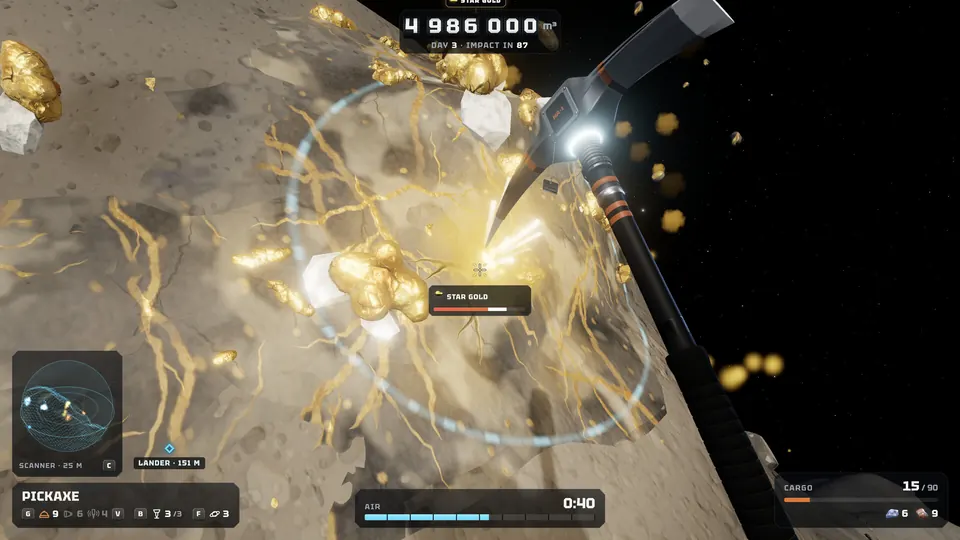
- Guaranteed Early Star Gold: Every single one of the six landing pads spawns 2 guaranteed Star Gold surface outcrops within 30–50 metres (plus 8 more scattered across the surface). Sweep a 50 m circle around your lander on Days 1–3 with the
Cscanner to fund your Sledgehammer and Drill immediately. - Space Crystal Geodes: Instead of narrow seams, Space Crystal forms roughly 60 hollow geodes (
4.0–7.5 mradius) between 15% and 60% depth, plus 6 surface outcrops and an ice grotto. Breaking into a geode yields dense clusters with minimal rock clearing. - Neutronium Core Vault & 8 Radial Pillars: At the exact center of the asteroid, a hollow 6.5 m vault (housing the empty "Asteroid defense budget" Safe museum find) is encased in a 9 m Neutronium shell, with 8 radial Neutronium pillars extending outward to 56%–66% depth. Bring at least 3.0 Power (Plasma cutter or upgraded Laser/Missile swarm) before tunneling in.
- Three Cave Tiers & Gas Hazards: Natural tunnels generate in three depth bands—Shallow (6%–20% depth, 6 systems with 0–2 surface mouths), Mid (28%–44% depth, 5 systems), and Deep (52%–70% depth, 3 systems)—alongside roughly 70 pressurized gas pockets (10%–65% depth, draining 15 s of air in a
6 mradius if breached at point-blank range). - Dark Matter Across Shallow Layers: Unlike Neutronium, Dark matter spawns as shallow as 5% depth (~70 veins), and v1.0.2 gave it a visible glow. Mark shallow veins with a Beacon or remember them until you reach 2.6 Power.
How the Market Glut Formula Works (Avoid Overselling)
Every morning each mineral's unit price fluctuates between 0.75× and 1.35× (further boosted by Refining at +6% per level, or +3% on new Hard Way saves). However, dumping thousands of units of a single mineral in one transaction triggers diminishing returns governed by the exact market depth curve:
Payout = floor(unitPrice × s × ln((s + r + n) / (s + r)))
s(Effective Market Depth): Base glut threshold multiplied by your Buyers skill multiplier (1 + Buyers level × 0.20in standard mode, or+0.10per level on new Hard Way saves).r(Carried-Over Saturation): Prior units already saturating that mineral's market.n(Units Sold Now): Quantity you are selling in this batch.- Overnight Glut Recovery (50% Daily Reset): Every morning, carried-over saturation
ris cut in half, freeing up demand for the next shift. - Practical Selling Strategy:
- Watch Low-Glut Ores: Titanium (
s = 300), Nickel (s = 400), Dark matter (s = 800), and Antimatter (s = 800) crash in marginal value quickly if you dump a huge stack all at once. - Spread Huge Sales Across High-Price Days: If a high-value ore rolls a low daily multiplier (
0.75×–0.90×) or already has heavy glut, hold part of your stock aboard ship sordecays by 50% overnight and wait for a1.20×–1.35×spike. - Invest in Buyers Late-Game: Once ship guns and Tractor Beam flood your hold with thousands of units per shift, leveling Buyers ($20,000 base, +20% market depth per level, max Lv 10) multiplies
sup to3.0×and preserves massive revenue.
- Watch Low-Glut Ores: Titanium (
Day 35 Ordinary Rock Sales & Ship-Gun Capture
Starting on Day 35 of Year 1 (and from Day 1 in Year 2+ NG+ runs or post-contract asteroids), all five ordinary rock layers sell for $2 per unit:
- Mineral Priority: Valuable minerals always take priority over ordinary rock in your backpack and ship hold; ordinary rock automatically fills leftover capacity.
- 30% Ship-Gun Rock Capture: Automated ship weapons paired with the Tractor beam capture 30% of blasted ordinary rock volume into your ship hold alongside liberated minerals—turning your orbital barrage into steady passive cash every shift.
Want to test exact 1-day vs. 2–3 day sell payouts or check your tool Power breakpoints? Open our interactive No Asteroids Calculator (Market Glut, Tool Power & Ship Guns), track rare finds in our Museum Finds & Set Bonuses Checklist, or check full weapon specs in the Tools, Drones & Ship Weapons Guide.
Ores & Market Selling FAQ
What is the most valuable ore in No Asteroids?
Antimatter has the highest base price at $150 per unit (daily market range $112–$202), followed by Dark matter at $68 ($51–$92) and Neutronium at $45 ($34–$61). Watch out when mining Antimatter: breaking a node drains 8 seconds of air within a 4-metre blast radius.
Which ores and rock layers require higher tool Power?
Two minerals require minimum tool Power: Dark matter requires 2.6 Power and Neutronium requires 3.0 Power. Among rock layers, Deep stone requires 1.2 Power, Basalt requires 1.9 Power, and Core metal requires 2.3 Power.
Why do ore prices drop when you sell a lot at once in No Asteroids?
Dumping a huge stack of one mineral at once saturates its market glut threshold (s) according to a logarithmic curve, reducing payout per unit on excess volume. Half of each mineral's saturation clears every morning (0.5x overnight), and leveling the Buyers skill increases s by +20% per level.
Where is the easiest place to find Star Gold early?
Every landing pad spawns 2 guaranteed Star Gold outcrops within 30 to 50 metres, plus 8 more outcrops scattered on the surface. Press C to ping your mineral scanner near the lander during Days 1–3 to spot them immediately.
When can you sell ordinary rock in No Asteroids, and how much does it pay?
Ordinary rock sales unlock on Day 35 in Year 1 (and Day 1 in Year 2+ or post-contract jobs) at $2 per unit. Rock only fills leftover cargo capacity behind valuable minerals, and ship guns with a Tractor Beam capture 30% of blasted rock into your ship hold.